
Consciousness Part II: THE ARTIFACTS
AKA: Mysticism, "Divine Science", and the Ongoing Struggle Between Spirit & Institution

This is Part II in a series, continued from PART I: THE PROBLEM
PART II: THE ARTIFACTS
What if consciousness isn’t something that emerges from the physical world - but something the physical world emerges from? Or at the very least, something woven into reality from the very beginning of whatever this physical world really is?
This is not New Age hand-waving. This is not crystal spheres, burning sage, chanting mantras in languages you don’t actually speak (or understand), or vision boards. This is a position defended in peer-reviewed journals by philosophers at NYU, Oxford, and the Australian National University, by Nobel Prize-winning physicists, and by neuroscientists at institutions worldwide. It’s the subject of major conferences, dedicated research centers, and a rapidly expanding body of rigorous literature.
And it’s the fastest-growing position in philosophy of mind.
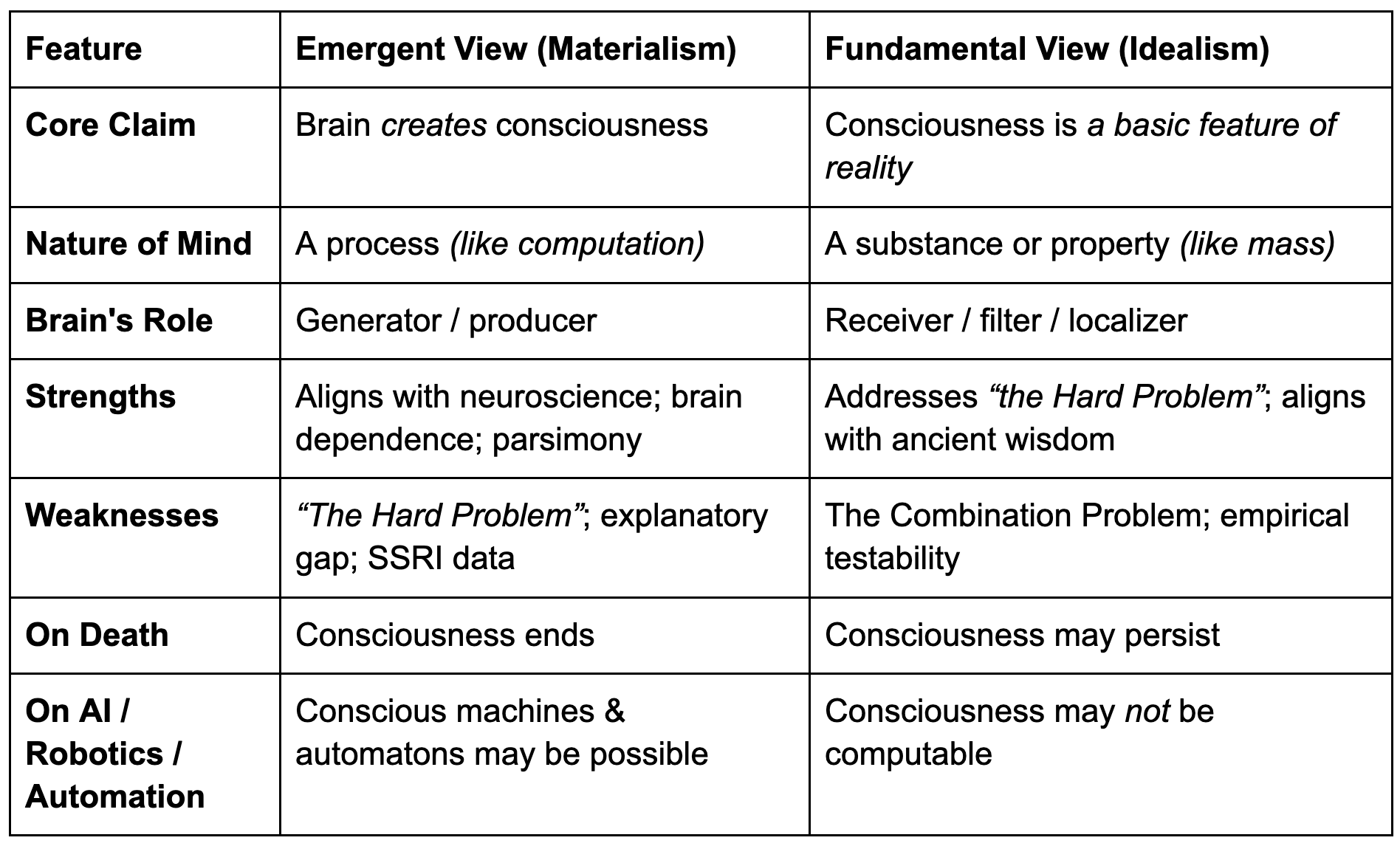
Let me lay out a summary of where the two views currently stand, because you’ll need to see the full landscape before we dive into the deep history and artifacts.
Now, the evidence for the fundamental view isn’t just modern. It’s written in stone and stars and sacred texts across every inhabited continent, spanning tens of thousands of years, and predating even what modern people consider the oldest concepts of God or the universe. What we’re about to walk through isn’t a parade of curiosities. It’s a case file. These are the artifacts of a consciously constructed reality - and once you see the pattern, I promise you won’t be able to unsee it.
PART IIA: THE DIVINE SCIENCES
Astrology as Consciousness Technology
Stick with me here- you’ll see how this ties in before too long, but you might need a primer.
Most people think astrology was invented once and then spread.
They’re wrong.
It was invented everywhere. And the journey of how it traveled - and how it survived - is one of the great intellectual adventure stories of human history.
The earliest recording of Astrological divine science is from ancient Mesopotamia, in the Fertile Crescent of the river valleys between the Tigris and Euphrates, during the first dynasty of Babylon around 1950–1600 BC. But this was emphatically not personality-focused horoscope astrology. Forget your daily horoscope - this was mundane astrology, a discipline of statecraft. Highly trained specialists - an intellectual elite of scribes, priests, and exorcists - meticulously observed celestial movements and compiled their findings into vast omen collections. The most famous was the Enuma Anu Enlil, a 70-tablet cuneiform library containing approximately 7,000 celestial omens- several of which still exist and are translated to English today.
And here’s a detail that shows how seriously the ancient Babylonians took this: the omens weren’t understood as iron-clad fate. The gods’ will was considered malleable. If an unfavorable omen appeared - a lunar eclipse portending the king’s death - elaborate rituals could avert disaster, including the chilling “substitute king” ritual, where a proxy would literally absorb the intended fate. For the Mesopotamians, the cosmos was a communicating entity, sending signals that intelligent trained minds could read - and respond to.
Simultaneously, in ancient Egypt, priests were developing their own celestial observation systems - tracking the heliacal rising of Sirius (which predicted the life-giving Nile flood), building monumental structures aligned to precise astronomical events, integrating celestial cycles into their multi-layered model of the soul and the afterlife. The Egyptians didn’t call it “astrology” as we understand it, but they lived within a cosmos where the events of heaven and earth were inextricably linked - where what happened above shaped what happened below.
The Hermeticists would later crystallize this as the Principle of Correspondence: As above, so below; as below, so above. Egypt was living that principle before anyone wrote it down.
Then the Greeks and Romans transformed it utterly. In the Hellenistic period, particularly in the cultural crucible of Alexandria, Babylonian celestial mechanics fused with Egyptian cosmology and Greek philosophical rationalism - especially the Stoic concept of “cosmic sympathy,” the idea that all parts of the universe are interconnected. This synthesis birthed horoscopic astrology - the natal chart as a symbolic map of an individual’s soul, life path, and possibilities for their destiny. Ptolemy’s Tetrabiblos sought to create a systematic, rational framework. The planets became archetypal forces: Saturn as limitation, Jupiter as expansion, Mars as assertion, Venus as attraction, and Mercury as perception. The zodiac signs became fields of experience. The houses of the zodiac grounded these energies in concrete life domains.
But here’s the chapter of astrology that almost nobody talks about. Jewish mystics adapted and deepened these traditions through Kabbalah. They wove astrological knowledge into their mystical framework, developing methods for calculating celestial influences from names and birth dates, integrating the zodiac into one of the most sophisticated inner traditions the world has ever produced. The Kabbalists didn’t just borrow astrology - they deepened it. They saw the celestial patterns as reflections of the same divine structure that organized the letters of creation themselves.
Then came a near-extinction level event.
During the medieval period - as the Roman Empire crumbled, libraries burned, and Europe descended into intellectual darkness - much of this accumulated wisdom was at risk of being lost entirely. The Greek texts. The Babylonian star catalogs. The Egyptian astronomical traditions. All of it teetering on the edge of erasure.
It was Arab and Islamic scholars who saved it.
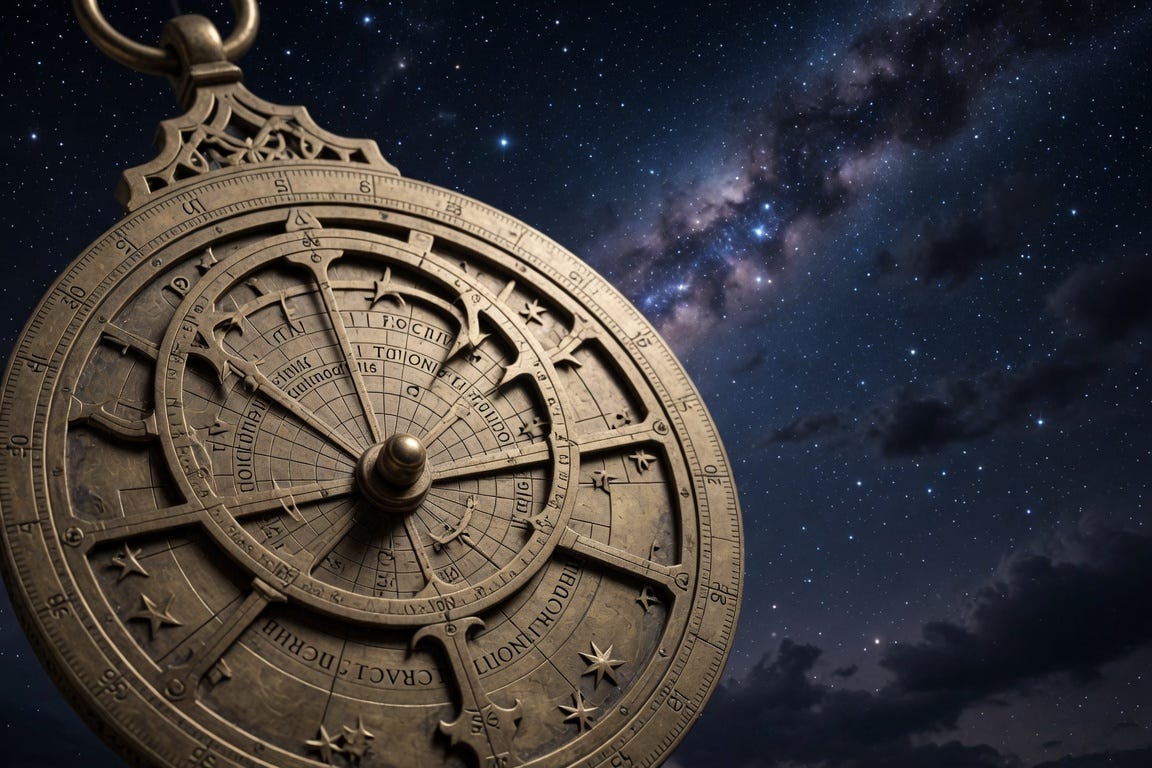
During the Islamic Golden Age - roughly the 9th through 13th centuries - a massive translation movement brought texts from Greek, Syriac, Persian, and Sanskrit into Arabic. The House of Wisdom in Baghdad, established under the Abbasid caliphs, became one of the greatest centers of learning the world has ever known. Scholars like Abu Ma’shar al-Balkhi didn’t just preserve - they actively advanced astronomical and astrological knowledge. They critiqued Ptolemy’s errors. They developed new mathematical techniques and instruments like the astrolabe. They questioned whether the Earth might rotate on its axis - centuries before Copernicus. Many stars still bear Arabic names: Aldebaran, Altair, Deneb.
Without Arab and Islamic scholars, most of this thread - from Babylon through Greece through Rome - might have been erased. They saved it from oblivion during the very period - the Crusades - when European and Islamic civilizations were at war. In the middle of a centuries-long military conflict, scholars on the “enemy” side were quietly preserving and advancing the knowledge that would reshape Western civilization for centuries to come.
Meanwhile on the other side of the planet- with zero known input from any of the cultures we’ve mentioned so far- Vedic astrologers in India were developing their own celestial science entirely independently. The Vedāṅga Jyotiṣa, attributed to the sage Lagadha, is one of the oldest known astronomical texts - with traditions possibly reaching back to 1400 BC. It was originally a system of timekeeping for Vedic rituals, using a sidereal system based on 27 nakshatras - lunar mansions that divide the ecliptic into equal sectors. Not borrowed from Babylon. Not influenced by Greece. A separate civilization looking at the same sky and arriving at a structurally similar conclusion: the cosmos is meaningful, patterned, and connected to human destiny.
Multiple civilizations, separated by thousands of miles with no documented contact, independently developed systems for reading cosmic patterns as maps of consciousness and destiny. Mesopotamia. Egypt. Arabia. India. They all arrived at the same basic intuition: what happens in the sky mirrors what happens in the soul.
I want to pause and flag something clearly as speculative - but I think it’s one of the most intriguing observations in this entire series.
If you take the fundamental view of consciousness seriously - if you entertain even the possibility that awareness is woven into reality itself - then this convergence starts to look less like coincidence and more like... well, you could almost call it a kind of quantum entanglement of global consciousness.
Multiple nodes in a conscious universe, independently tuning into the same signal. Each civilization, through its own unique cultural lens, picking up the same broadcast.
Now, to be clear: that’s speculative. Maybe wildly speculative. But it’s intriguing enough to mention in this essay.
So, the modern resurgence is equally telling. Despite scientific materialism’s dominance, these mystical systems of divine science aren’t dying - on the contrary, they’re exploding! The U.S. psychic services industry hit $2.3 billion in 2024, with revenue growing over 4% annually since COVID. The global astrology market, valued at $12.8 billion in 2021, is projected to reach $22.8 billion by 2031. A 2024 Pew survey found roughly 30% of American adults engage with astrology annually. And that number/growth rate just keeps growing every time it’s measured.
But why?
In the most scientifically literate era in history, why are mystical ancient symbolic systems growing faster than ever? Because mainstream culture gives you two options for understanding yourself:
Neuroscience (you’re a meat computer running chemical software) or
Consumer Identity (you are what you can buy- and if you can’t afford much then you’re literally nothing).
To be clear, in this essay, I’m including the historical practice of the sale of indulgences by the Catholic Church for several hundred years, up to the council of Trent, as well as the modern pseudo-christian belief of the so-called “Gospel of Prosperity” and the recent phenomenon of OnlyFans girls suddenly turning to Jesus- but only after becoming either fabulously wealthy or skidding out of popularity. And as Rabbi Shaul Magid notes, even secular Jews have fallen prey to similar lines of thinking. And of course if you need examples of this same spiritual fallacy among Muslims, look no further than Dubai, Abu Dhabi, or Riyadh- these are cities that I think the Caliph would prefer we all not pay attention to, spiritually.
Under consumer identity, if you haven’t extracted the maximum amount of fun or money possible from this world, then even God hates you, you’ll be miserable in this life, and your soul will likely suffer even longer after you’re dead.
On the face of it, neither the neuroscience nor the consumer identity option speaks to the felt sense that most humans have as a conscious being with an inner life, with patterns and struggles, and a relationship to something larger.
But Astrology does. Every day. Like clockwork. Without respect to background, pedigree, or creed.
And millions of people are voting with their attention.
Now, intellectual honesty demands that I also mention that from the perspective of modern science, so far, astrology has no empirical basis as a predictive or descriptive tool. Several studies have repeatedly failed to find correlations between planetary positions and personality traits or life events. No known physical mechanism exists by which distant planets could influence human destiny.
So if it’s not scientifically validated, why are we talking about it? Because the value may lie not so much in prediction as in function - and that function points to something deep.
Astrology’s symbolic vocabulary is arguably richer than any modern personality typology.
After all, Myers-Briggs is infamous for having poor test-retest reliability. The Enneagram has virtually no peer-reviewed validation. And even the Big Five personality dimensions are widely oversimplified in their popular form.
Yet all of these can be used productively because they give people a vocabulary for talking about their inner lives.
So here’s the speculative bridge - and I’m going to mark this as clearly as speculative. If we take the fundamental view of consciousness seriously, the Hermetic “as above, so below” takes on new resonance. Planets and numbers wouldn’t be causing events through physical forces. They could be synchronistically reflecting the same underlying patterns of a conscious universe that also unfold within our lives.
Not prediction. Pattern recognition.
Not causation. Correspondence.
If reality is information - and a growing body of physics suggests it is - then it’s totally plausible that astrology is a complex and ancient UI. A symbolic operating system for interfacing with the structure of a conscious cosmos.
A widget for understanding it all.
But just one of many...
Numerancy: Numerology & Gematria
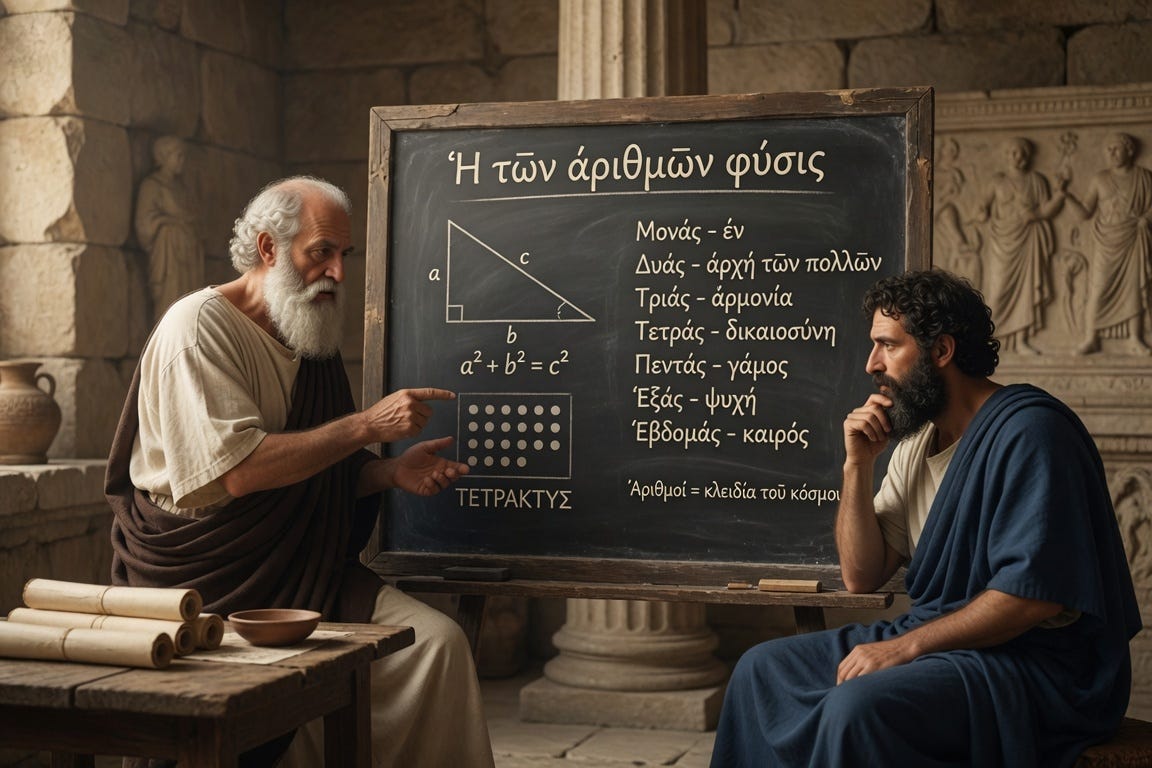
Around the 6th century BC, on the Greek island of Samos, Pythagoras proposed an idea so radical it essentially founded Western mathematics and metaphysics simultaneously: the universe is built from numbers. Not just described by numbers - constituted by them. Numbers aren’t human inventions. They’re the architecture of reality itself.
His breakthrough discovery - that musical harmony corresponds to simple integer ratios - led to the concept of the so-called “music of the spheres.” The planets, moving according to mathematical laws, produce a type of celestial harmony. The cosmos is, at its deepest level, mathematical music.
This resonates- pun intended- with the Hermetic Principle of Vibration, which states: Nothing rests; everything moves; everything vibrates.
Pythagoras heard the vibration in the intervals between notes and realized it was the same vibration that moves the planets.
Central to Pythagorean philosophy was the Tetractys - a triangular figure of ten points symbolizing how the cosmos unfolds from unity (1) through duality (2), harmony (3), and, finally, material manifestation (4). These ideas profoundly influenced Plato and, through him, the entire Western intellectual tradition through multiple renaissances of NeoPlatonic ideals- how’s that for resonance?!
When serious physicists today say the universe is “made of math” - they’re acting more like mystical Pythagorean zealots than they might realize.
Modern Pythagorean numerology applies this to the individual:
the Life Path Number (core identity and purpose),
Expression Number (talents and potential),
Soul Urge Number (inner desires) - all calculated from birth dates and names.
Like astrology, modern numerology offers a structured vocabulary for self-reflection - a framework for articulating what you sense about yourself but can’t quite name.
Before binary, there was sacred geometry.
And before algorithms, there was gematria:
Jewish mystics took the numerical cosmos further through Kabbalah and gematria - the numerological system used to assign values to Hebrew block letters to unlock hidden meanings in sacred texts, as part of the system of formalizing the written language after centuries of using Paleo-Hebrew. The Sefer Yetzirah, possibly dating to the 2nd century AD, elaborated a system linking creation itself to letters and numbers. Kabbalists saw this new Hebrew language as the building blocks of reality - each letter possessing spiritual significance and mathematical resonance. They developed methods for calculating zodiac signs and planetary influences from names and birth dates, weaving both astrology and gematria into one of the most sophisticated mystical traditions the world has ever produced. Or perhaps just the most complicated. Depends on who you ask.
Meanwhile, China developed BaZi - the Four Pillars of Destiny - calculating life path from the exact year, month, day, and hour of birth. Each “pillar” consists of a Heavenly Stem and an Earthly Branch, mapped to the Five Phases - Wood, Fire, Earth, Metal, Water - and Yin/Yang polarities. Your Year Pillar reflects ancestry and social context. Your Month Pillar reveals parents and career foundations. Your Day Pillar - the most important - reveals your “Day Master,” your core self. Your Hour Pillar illuminates your inner life, dreams, and later years.
The system analyzes how these elemental forces interact - productive cycles, controlling cycles, balances and imbalances - creating what is essentially a personality-and-destiny diagnostic chart formalized over a thousand years ago. BaZi practitioners explicitly distinguish between “Heaven Luck” (what you’re born with), “Man Luck” (what you create through choices), and “Earth Luck” (how environment shapes you). The system acknowledges agency. It’s analytical. It’s nuanced. And it was developed with zero input from Greece, Egypt, or Mesopotamia. Another independent node. Another culture tuning into the same signal.
Like most mystical traditions, numerology has no empirical basis as a predictive science in the conventional sense. But much like astrology, it gives people something mainstream culture conspicuously lacks: a structured language for the inner life. And to the intellectually honest, this cross-cultural convergence is hard to dismiss entirely.
Three traditions - Pythagorean, Kabbalistic, Chinese - separated by oceans and centuries, all arriving at the same conviction: reality has a numerical architecture, and the patterns in that architecture correspond to patterns in consciousness itself. That’s either a remarkable coincidence or a remarkable clue.
And if you’re a materialist, you can explain this convergence by saying all these cultures share the same human neurology and the same mathematical patterns in nature. Fair. But notice what that explanation concedes: that mathematical structure really is fundamental to reality, and that human consciousness has an innate capacity to perceive it. That’s already a bigger concession than most materialists realize they’re making.
I Ching: The Original Algorithm
The I Ching - the Book of Changes - is one of the oldest and most influential texts in human civilization, with roots stretching back over 3,000 years to the Shang Dynasty oracle bone traditions. Its system of 64 hexagrams, each composed of six lines of yin or yang, represents archetypal situations and processes in human experience. Originally a divination manual, it evolved into a foundational philosophical work that shaped Confucianism, Taoism, and virtually every dimension of Chinese intellectual life.
But here’s what makes the I Ching genuinely mind-bending from a computational standpoint. Sixty-four hexagrams. Six binary lines each. That’s a complete six-bit binary state space - every possible combination of on/off across six positions. Leibniz, the co-inventor of calculus, recognized this when he encountered the I Ching in the 17th century. He was already developing binary arithmetic - the foundation of all modern computing - and was stunned to find that Chinese sages had mapped the same mathematical structure three millennia earlier. Only, Chinese gurus weren’t using it to run machines.
They were using it to read reality.
The philosophy behind the I Ching is rooted in a view of the cosmos as an organic, continuous process - holistic and dynamic, without beginning or end. Everything is in flux. Everything is connected. The question isn’t whether reality is changing - it always is - but how to navigate that change wisely.
This is the Hermetic Principle of Rhythm made into a working technology: Everything flows, out and in; everything has its tides; all things rise and fall.
Now, Carl Jung’s connection to the I Ching runs much deeper than the over-quoted “synchronicity” sound bites suggest. What most people miss is that Jung didn’t just write about the I Ching - he actually used it. For decades. He consulted it during pivotal moments of his intellectual life, including while he was developing his theory of archetypes. In his foreword to Richard Wilhelm’s translation of the Book of Changes, Jung was careful to say he wasn’t endorsing it as magic. He was proposing something more radical: that at the moment of a genuine inquiry, the state of the questioner’s consciousness and the state of the cosmos are not separate events. The hexagram you cast doesn’t predict your future. It mirrors the pattern you’re already inside of. That’s not mysticism dressed up as philosophy - it’s a testable claim about the relationship between observer and observed. And it sounds remarkably like what quantum mechanics was discovering at the exact same historical moment.
And then there’s the late Terence McKenna, who took the I Ching somewhere nobody expected. McKenna didn’t just use the hexagrams for divination - he treated the King Wen sequence as pure data. He analyzed the 384 lines of change across the 64 hexagrams and extracted a mathematical waveform he called the Timewave - a fractal pattern that he claimed mapped the ebb and flow of “novelty” across all of history. Novelty meaning newness, complexity, dynamic change - the opposite of habit and stasis.
Now, McKenna’s specific predictions didn’t pan out, and the mathematical rigor has been contested. Fair criticism. But the general direction was largely correct in my opinion, and here’s what most critics miss: McKenna was treating a 3,000-year-old divination text as a dataset and running what was essentially pattern analysis on it. He was asking: is there a signal in this structure? Is the sequence encoding something about the nature of change itself? That’s not mystical thinking. That’s a computational question applied to ancient wisdom. And whatever you think of his answers, the fact that he was even bothering with this question is objectively brilliant.
Strip away the psychedelic mystique and you’ve got something genuinely fascinating: a 3,000-year-old machine learning model trained on the structure of change. Not trained on data the way we train models today - trained on direct observation of reality’s patterns by minds operating in non-ordinary states of consciousness. That’s a different kind of training data. And maybe a different kind of intelligence.
But here’s the thing that ties the I Ching back to everything else we’ve been exploring. The ancient Chinese didn’t treat the cosmos as a dead mechanism ticking along blindly. They treated it as a communicating entity - alive with meaning, structured by pattern, responsive to inquiry.
The I Ching is a technology for conversing directly with reality:
Ask a genuine question.
Cast the hexagram.
Read what the structure of that moment has to say.
Whether you believe that “works” in any literal sense or not, the structural assumption behind it is identical to the one modern panpsychism and idealism are now defending with formal arguments and mathematical models: the universe has an interior. It’s not just dead matter behaving according to equations. There is something that it is like to be this cosmos. And that something is, at some level, responsive.
PART IIB: THE PHILOSOPHICAL TRADITIONS
Christianity’s Consciousness Wars
Now, if you think these ideas about consciousness as fundamental belong only to Eastern religions and ancient pagans, you haven’t read your Church history closely enough.
Christianity has spent roughly 1,500 years arguing over (sometimes even spilling blood over) a single question:
Is consciousness in us, or is it us?
Start at the beginning. Origen of Alexandria, one of the most brilliant minds of the early Church - 3rd century - proposed that human souls were created by God before conception, that they existed as pure nous - intellect, awareness - in a state of contemplation of the divine before descending into matter. The soul wasn’t a product of the body. The body was a vehicle for the soul. Origen was essentially an idealist operating within a Christian framework: consciousness first, matter second.
The institutional Church eventually condemned him. The Second Council of Constantinople in 553 AD declared the pre-existence of souls anathema. Not because it was philosophically weak - but because it was theologically uncontrollable at that time. If souls exist before bodies, if consciousness is primary, then the Church’s gatekeeping of the soul’s relationship to God becomes... well.. optional.
Augustine took a different route but arrived at a similar shore. His theory of divine illumination proposed that human minds can only grasp eternal truths - mathematical certainties, logical necessities, moral absolutes - because God’s light shines directly on the intellect. The human mind doesn’t generate truth. It receives it. Like a window participating in sunlight - change the angle, get a different view, but the light was never yours. Augustine frequently used the metaphor of the sun: just as sunlight makes physical objects visible, God’s light illuminates the “eye” of the intellect, revealing eternal truths that no finite, changing human mind could generate on its own.
Sound familiar? That’s the antenna model, dressed in 4th-century theology. The brain - or in Augustine’s case, the soul - doesn’t produce the signal. It receives it. And the quality of the reception depends on how well the instrument is tuned.
Then came the medieval mystics.
This is where it gets, well, a bit spicy.
Meister Eckhart, 13th-century Dominican friar, preached that the soul contains a “spark” - ein Fünklein - that is identical to the essence of God. Not similar to God. Not created by God. Identical. “God’s ground is my ground, and my ground is God’s ground,” he wrote. Within this spark lies what Eckhart described as “something like the original outbreak of all goodness” - a brilliant, incessantly gleaming light. The spark doesn’t just connect to divinity - it is divinity. It seeks what Eckhart called the “naked God” - not the God of dogma or scripture, but the silent, still ground beyond all distinctions, even beyond the Trinity itself. A “desert” of pure being where the observer and the observed dissolve into one.
Strip away the Christian vocabulary and Eckhart is saying exactly what the Upanishads said: “Tat Tvam Asi - Thou art That.” The innermost consciousness is the universal consciousness. He even described the path to this realization in similar terms: emptying, letting go, releasing the ego’s grip until only pure awareness remains.
The Catholic Church of course condemned these ideas as heresy- by Pope John XXII in 1329- but has gone on record stating clearly that Meister Eckhart himself was never condemned in the trial. Some scholars today argue that Eckhart’s ideas may have been influenced by Arab philosophical texts that filtered into medieval Europe - the same texts preserved during the Islamic Golden Age that we discussed earlier. If so, the thread connecting Babylonian star-wisdom to Islamic preservation to Christian mysticism might be even more direct than most people realize.
Then there was Teresa of Ávila, in the 16th century, who mapped seven “mansions” of the Interior Castle - stages of the soul’s journey inward toward union with God. Each mansion represents a distinct state of consciousness. The first mansions describe the soul distracted by worldly concerns, barely aware of its own depth. The middle mansions chart increasing receptivity - the “prayer of quiet,” where active striving gives way to passive receiving, and supernatural contemplation begins. The sixth mansion is perilous: raptures, visions, “wounds of love” - the soul suspended between worlds. And the seventh? “Spiritual marriage” - complete, habitual unity with the divine, where prayer becomes an uninterrupted conversation with God and the soul perceives reality through a lens of pure love.
Teresa described the castle itself as a magnificent crystal or diamond, with God - the “King of Glory” - dwelling at the center, radiating light outward. The closer you get to the center, the brighter the light. Most human beings, she said, live in the outer courtyard, trapped by egoic pursuits, unaware that a king (the king of kings) is just around the corner, living inside.
The progression is remarkably similar to the Mandukya Upanishad’s four states - Waking, Dreaming, Deep Sleep, Turiya - arrived at independently, from within a completely different tradition, a thousand years apart. Teresa was a contemplative neuroscientist working without instruments. And her interior castle is a consciousness map that still hasn’t been surpassed.
And while the institutional church of her era was often focused on doctrinal control, Teresa represents figures like Meister Eckhart in the 13th century who spoke of a divine spark identical to God’s essence. These were people who understood, from within Christianity itself, that the observer and the observed are ultimately one. It should be noted that in 1970, the Catholic Church under Pope Paul VI, named Teresa of Ávila a Doctor of the Church- the first woman ever to become one. But equally important: her reforms were actually approved within her own lifetime.
The Quakers took the most radical institutional step. George Fox, 17th century, founded the Society of Friends on a single, explosive premise: the “Inner Light.” After finding no truth in existing churches, Fox reported hearing a voice: “There is one, even Christ Jesus, that can speak to thy condition.” His conclusion: God speaks directly to every individual’s consciousness, without need for priest, sacrament, or scripture as intermediary. The Inner Light isn’t conscience - it’s something deeper, a divine presence that informs and sometimes corrects conscience itself.
If you’ve been tracking the Hermetic principles, you’ll recognize this as the Principle of Mentalism applied to spiritual practice: if The All is Mind, then every mind has direct access to The All. No middleman required. The Quakers built an entire religious sect on that premise - silent worship, collective listening, radical equality - and it’s still going.
And threading through all of this - from the very first century - the Gnostics. The Valentinian and Sethian Gnostics saw human consciousness as fragmented sparks of a divine light trapped in matter, longing to return home. They didn’t want to read about the Divine. They wanted to merge with it. Gnosis - direct experiential knowledge of transcendent reality - was the entire point. There was always a wing of the faith that prioritized direct experience over dogma, that used the available divine sciences to help achieve individual divine purpose.
The institutional Church suppressed the Gnostics with extraordinary thoroughness. Texts were burned. Communities were dispersed. Adherents were persecuted. The Council of Nicaea in 325 AD, convened by Emperor Palpatine- ahem- sorry, wrong Emperor- I meant Constantine. The Council of Nicaea consolidated orthodox doctrine into a cohesive matrix of governance and contributed to the systematic erasure of Gnostic teachings. The exclusion of Gnostic texts from the biblical canon after nearly 300 years of popular use was a defining moment - narrowing the spiritual vocabulary available to future generations.
And the suppression nearly succeeded. For over 1,500 years, Gnostic beliefs were known almost exclusively through the hostile writings of the Church Fathers who opposed them - like reconstructing a defendant’s case entirely from the prosecutor’s notes, without ever allowing the defendant himself to give his own testimony. Then, in 1945, near the Egyptian town of Nag Hammadi, a farmer digging for fertilizer unearthed a sealed clay jar containing 52 Gnostic texts - the Nag Hammadi codices. Buried by someone, possibly a monk from a nearby monastery, who was preserving them from orthodox destruction. The texts revealed a far more diverse early version of Christianity than the official history allowed - one where direct experience of the divine was not a heresy but the whole point.
The big problem? Let me say it plainly: the suppression of Gnosticism wasn’t primarily a theological correction. It was an institutional immune response. If salvation comes through personal gnosis - direct knowledge of transcendent reality - then the need for priests, sacraments, and the Church’s gatekeeping of truth becomes, again, optional. When people discover they can access divine consciousness directly - without intermediary, without hierarchy, without permission, and without paying - they become very difficult to control.
The history of Christianity’s relationship to consciousness is, at its core, a 1,500-year argument about whether you need a middleman to access your own deepest nature.
Origen said consciousness precedes the body. Augustine said the mind receives divine light directly. Eckhart said the soul’s ground is God’s ground. Teresa mapped the journey inward through seven states. Fox said the Inner Light speaks to every person without mediation. The Gnostics said divine sparks are trapped in matter, longing to return home. They all said no middleman. And they were all, in various ways, punished for it, marginalized, condemned, or suppressed.
But the tradition of the inner light never actually disappeared. It just went underground. And it keeps resurfacing - because the direct experience it describes keeps happening to people, permissionlessly, spontaneously, regardless of what the institutions say should be happening.
Ancient Wisdom Montage
Let’s be very clear: The idea that consciousness is fundamental isn’t a modern invention.
Heck, it isn’t even a recent invention.
It is arguably the default position of human civilization for the vast majority of our species’ existence.
From the Vedic sages of India to the shamans of southern Africa, from the mystery schools of Greece to the songlines of Aboriginal Australia - culture after culture arrived at the same core intuition: the inner world of awareness is not a biological accident.
It is the primary reality.
We can’t claim a 40,000-year-old cave painting is “evidence for panpsychism” in any scientific sense. But we can say the fundamental view has deep, independent, cross-cultural roots - and that these traditions developed sophisticated technologies for exploring consciousness directly. That convergence is, at minimum, suggestive. But taken just a little more seriously, it’s a clue we’d be foolish to ignore.
The Vedic Tradition - Atman Is Brahman.
The Upanishads - composed roughly 800–200 BC, drawing on far older oral traditions - represent the most systematic ancient exploration of consciousness as fundamental reality. The precision of their analysis is, frankly, humbling.
Brahman is the ultimate, all-pervading reality of the universe - and here’s the crucial distinction from most mainstream beliefs about divinity - Brahman is not a personal god, not an ancient father with a white beard sitting on a throne, or a universal mother showing her beneficence to all humankind. Brahman is pure, limitless consciousness itself, described as Sat-Chit-Ananda: being, consciousness, bliss. The ground of all existence is awareness.
Atman is the individual self - not your personality, not your memories - but the pure witnessing awareness at the core of each living being. The observer behind your eyes.
But the thunderbolt- the insight that changed everything in Indian philosophy- is contained in the Advaita Vedanta tradition, and declares that Atman and Brahman are not two things. The famous Mahavakya - “Tat Tvam Asi” (”Thou art That”) - means your innermost consciousness is the universal consciousness. There is only one “experiencer” in the cosmos, appearing as many.
The Mandukya Upanishad maps four states of consciousness with extraordinary precision: Jagrat (Waking - experiencing the gross physical world), Svapna (Dreaming - experiencing a subtle mental world), Sushupti (Deep Sleep - undifferentiated consciousness without objects), and Turiya (The Fourth - not a state at all, but the silent witnessing ground of the other three).
Modern contemplative neuroscience has noted the structural similarity between Turiya and “pure consciousness events” - episodes of awareness without content, reported by advanced meditators across traditions, independently, millennia later.
Bernardo Kastrup’s “universal mind with dissociated alters” is, structurally, pretty much the exact same claim the Upanishads made thousands of years ago. Same model, just different methods. And there’s no evidence that Kastrup read the Upanishads first. He just arrived at the same structure through analytic philosophy and the failure of materialism to account for experience, by using first principles.
It’s fair to call this a Convergence.
In Ancient Sumeria - there was the Divine Spark in the Clay.
Go back even further. In the Sumerian creation epic Atrahasis - roughly 1700 BC - humanity is created by mixing clay with the flesh and blood of a slain god named We-ilu, whose name literally means “He who had intelligence.” This divine blood infused humans with ṭēmu - intellect, reason, consciousness - and a living spirit. This wasn’t written as a colorful myth. It’s an enduring theological claim: human awareness is not an accident of biology. It’s a divine component, a fragment of cosmic intelligence woven into human nature from the very beginning. The Sumerians intuited some 3,700 years ago that consciousness has a source beyond mere matter.
And in Ancient Egypt - there was the Multi-Faceted Soul. The Egyptians modeled the soul not as a single thing but as a multi-layered composite: Ka - the vital life-force, your energetic template. Ba - the personality, often depicted as a human-headed bird traveling between worlds. Akh - the transfigured luminous spirit, what you become if you pass the test. And Ib - the heart - where consciousness lived. The Egyptians considered the brain so unimportant they pulled it out through the nose during mummification and discarded it. But the heart was weighed against the feather of Ma’at - your consciousness itself was judged.
It’s tempting to think of this as a simple mind-body split. But to the ancient Egyptians, it was a much more complex composite model of consciousness as multi-dimensional, morally significant, and capable of transformation beyond death. That looks nothing like the barbaric, primitive world that Hollywood tries to sell us. It’s extraordinarily nuanced. And notice: the Egyptian model anticipated modern debates in ways that are almost eerie. The distinction between Ka (energetic template) and Ba (personality) maps loosely onto the distinction between life force and individual identity that still divides philosophers of mind. The idea that the Akh is something you become - that consciousness can be transformed through right action - is a developmental model of awareness. These people weren’t groping in the dark. They were building frameworks.
The Eleusinian Mysteries.
For nearly 2,000 years, the brightest minds of the Western world - Plato, Cicero, Sophocles, Marcus Aurelius - made a pilgrimage to Eleusis to participate in a secret ritual. They emerged transformed, claiming to have lost their fear of death. The penalty for revealing what happened inside was execution.
Initiates drank the kykeon - a sacred beverage that recent archaeological evidence, including ergot fragments in ceremonial vessels and dental calculus, strongly suggests contained psychoactive alkaloids closely related to LSD. Chemical research has demonstrated that ancient peoples could have processed toxic ergot using simple lye from wood ash to isolate LSA - a genuinely visionary compound.
The experience wasn’t about learning doctrines or memorizing creeds. It was about undergoing a direct, shattering encounter with something beyond the ordinary self. Participants described seeing a great light. Ego dissolution. Confronting death not as ending but transformation. Cicero wrote that among everything Athens had given humanity, “nothing is better than those mysteries.”
For two thousand years, in the cradle of Western civilization, a chemically induced altered state of consciousness was the most respected, most elite spiritual technology available. The greatest minds of the ancient world - philosophers, generals, emperors - went through this experience and came out saying it was the most important thing that ever happened to them.
That challenges the modern assumption that “serious” religion and “drugs” belong in separate categories. At Eleusis, they were one and the same. And if that makes you uncomfortable - good. Sit with it.
This is the Hermetic Principle of Polarity in action: Everything is dual; opposites are identical in nature, but different in degree. Sacred and profane. Medicine and poison. The kykeon was both - depending entirely on the degree of intention and preparation.
Panpsychism & Quantum Consciousness
So modern science spent three centuries insisting consciousness is produced by matter.
But now it’s circling back.
Panpsychism - the view that mind or some mind-like quality is a fundamental feature of reality - isn’t new. It has roots in Spinoza, Leibniz, William James, and Alfred North Whitehead. What’s new is the volume and quality of serious contemporary work defending it.
What panpsychism actually claims is that the most basic constituents of the universe - quarks, photons, strings- whatever lies at the bottom like large extra dimensions, axions, or dark matter WIMPs - that these particles might possess an incredibly rudimentary form of experience. A flicker of “something it’s like to be” that entity. Philip Goff calls it “micro-experience.” Human consciousness is what happens when trillions of these micro-experiences are organized into an unimaginably complex integrated structure - a brain. We are not the origin of consciousness. We are consciousness organized into a particular, spectacularly rich configuration.
Russellian Monism deepens this. Physics tells us what matter does - how particles behave, how forces relate. But it’s completely, utterly silent about what matter is in itself. What is an electron, beyond its mass, charge, and spin? What is its intrinsic nature? Physics gives us equations and relational descriptions, but the “stuff” those equations describe remains a total black box. It’s like having a perfect map of a city’s road network without knowing what the buildings are made of - or whether they contain any living humans instead of cardboard cutouts neatly placed on top of Roomba vacuums close to the windows. Russell proposed that the intrinsic nature of matter is experiential. Consciousness may be the inside of what physics describes from the outside. The “what it’s like” of matter. If that’s right, consciousness isn’t something extra that needs to be explained - it was there all along, hiding in plain sight in the foundations of physics.
Cosmopsychism takes this even further - a top-down variant where the cosmos itself is a single conscious entity, and individual minds are localized aspects within that universal consciousness. Think about that for a second. That’s not a mystical claim from an ancient text - that’s a position being argued in analytic philosophy departments right now.
Bernardo Kastrup makes the case for full-blown idealism with the precision of an analytic philosopher. He argues that all of reality is one universal mind. Individual consciousnesses - yours, mine, your dog’s - are “dissociated alters” of this one mind, the way a person with dissociative identity disorder has multiple centers of experience within one psyche. The physical world? It’s what mental activity looks like from the outside when one alter observes another. This isn’t metaphor - Kastrup argues it’s the most parsimonious interpretation of the available evidence. And yes, he’s very aware of how that sounds.
Donald Hoffman at UC Irvine takes a different but equally radical route. Spacetime and physical objects aren’t fundamental - they’re a “user interface.” A species-specific representation that evolution built to help us survive, not to show us truth. Your desktop icons aren’t the actual files - they’re a useful fiction. Hoffman argues physical reality is the same thing: a useful fiction, an interface. Behind it: a network of interacting “conscious agents.” And he’s formalized this into mathematical models that he claims are empirically testable.
Orch OR (Orchestrated Objective Reduction) - Penrose and Hameroff’s proposal that consciousness arises from quantum computations in microtubules - protein structures inside neurons - remains the most speculative of these frameworks. Penrose, a Nobel Prize-winning physicist, argues that consciousness involves non-computable processes - meaning no Turing machine, no matter how powerful, could replicate what the brain does. If correct, consciousness isn’t just generated by the brain - it’s plugged into the deepest level of physical reality itself. Many physicists doubt quantum coherence can survive in the warm, wet brain. But recent findings showing quantum effects in biological systems - photosynthesis, bird navigation - have kept the door stubbornly open.
And the implication goes even deeper: consider the Observer Effect.
In quantum mechanics, particles exist as waves of probability until the moment they are measured or observed. The act of witnessing actually collapses that probability into a single, physical reality. This suggests that consciousness is not a late arrival to the party. It is a fundamental requirement for the physical world to even manifest. No observer, no collapse. No collapse, no definite physical reality. Consciousness might not just be in the universe - the universe might require consciousness to be.
This is the Principle of Mentalism expressed in the language of quantum mechanics: The All is Mind. The universe is mental. And every time a physicist measures a particle and collapses its wave function, they are performing an act that - if you take the fundamental view seriously - is consciousness creating reality in real time.
Fairness demands we acknowledge the problems. The Combination Problem - how do billions of micro-experiences combine into the unified experience you’re having right now? - is panpsychism’s equivalent of the Hard Problem. Empirical testability is genuinely difficult. Critics charge that saying “consciousness is fundamental” just relabels the mystery.
But proponents counter that materialism faces equally severe problems, and the combination problem - while hard - is at least a tractable structural problem, unlike the seemingly in-principle impossibility of deriving subjective experience from purely objective physical description.
The Hermeticists said it first: The All is Mind.
So, is modern physics essentially just repeating the same thing, but with equations?
SOURCES LISTED IN PART III:
